This article is about USB 3.0.
USB 3.0 is capable of speeds of up to 5GBPS. This article
challenges the speed of USB 3.0 and compares it to other interfaces.
Shaun K. Mitchell
USB 3.0 has become the pinnacle of data transfer rates. It can
currently process bandwidth rates of up to 5 Gigabits per second. This can
translate to an average transfer of 640MBps, which is ten times faster than USB
2.0 which transfers at 64MBps.
Intel’s Thunderbolt platform (new Firewire) allows transfer
rates of up to 10GBps, twice that of USB 3.0.
The comparison lies in the difference of transfer speeds
between Thunderbolt and USB 3.0.
A few tests were carried out to determine if Intel’s
Thunderbolt technology was in fact faster than a USB 3.0 connection.
Data transfer rates between two different types of hard
drives were recorded. Data transfer rates were compared using a regular hard
drive and they were also recorded separately using a Solid State hard drive. A
regular hard drive works off platters and an actuator arm while a SSD works
solely of memory. A solid state drive is harder to break than a regular hard
drive but is conversely more expensive.
The tests were carried out using a StarTech USB hub and a
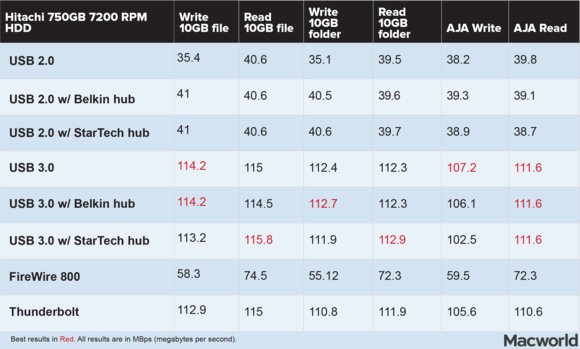
Belkin USB hub to test data transfer rates and involved a 2.5 inch Hitachi external hard
drive and a MacBook pro. A 10 GB file was transferred to each hard drive
through the below noted medium. (Macworld)
Regular Hard Drive
It was found throughout the testing procedure that all of the tests were in the 112MBps to 115 MBps range. Transfer through the Belkin hub was at 106MBps and transfer through the Startech hub the test score was 102MBps.
It was found throughout the testing procedure that all of the tests were in the 112MBps to 115 MBps range. Transfer through the Belkin hub was at 106MBps and transfer through the Startech hub the test score was 102MBps.
When results were recorded using a USB 2.0 hard drive, the
results were consistent at 41MBps. This is slower as expected due to the
architecture of the interface.
In Firewire 800 the transfer was just about half as fast.
The write scores were at 55 and 60MBps and the read scores were marginally
higher.
The thunderbolt scores, the test found were consistent with
the USB 3 scores which is surprising because the thunderbolt interface is
supposed to be faster than USB 3.
SSD
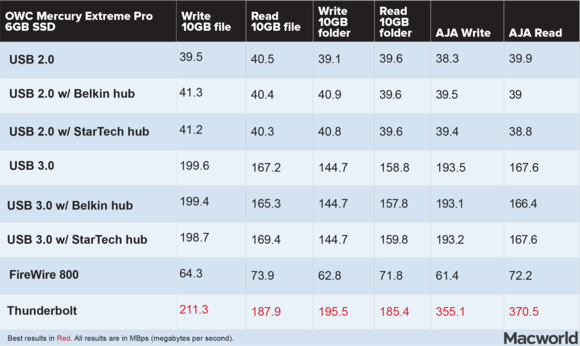
In a separate test, an OWC mercury extreme pro 6G SSD was
used. An SSD has different architecture and typically doesn’t take as long to
record information to the drive as it would with a regular hard drive. The tests
remained the same at 40MBps with USB 2.0 and the bottleneck appeared to be the
USB 2.0 drive/interface architecture.
USB 3.0 proved inevitably faster, at 200MBps. (macworld)
USB 3.0 in conclusion is fast, about three times faster on a
regular hard drive, and about three to five times faster with a Solid State
Hard Drive. It is faster than USB 2.0 but comparable to thunderbolt.
In summary, both USB 3.0 and thunderbolt appear to have
upsides and downsides. Both are good in their own ways and are comparable to
each other.

No comments:
Post a Comment